

I’m standing in front of a room full of people at Fabrik, a social space in Tribeca, and my heart rate slows down. Fifteen framed portraits from the last year and a half of my life hang on the wall behind me.
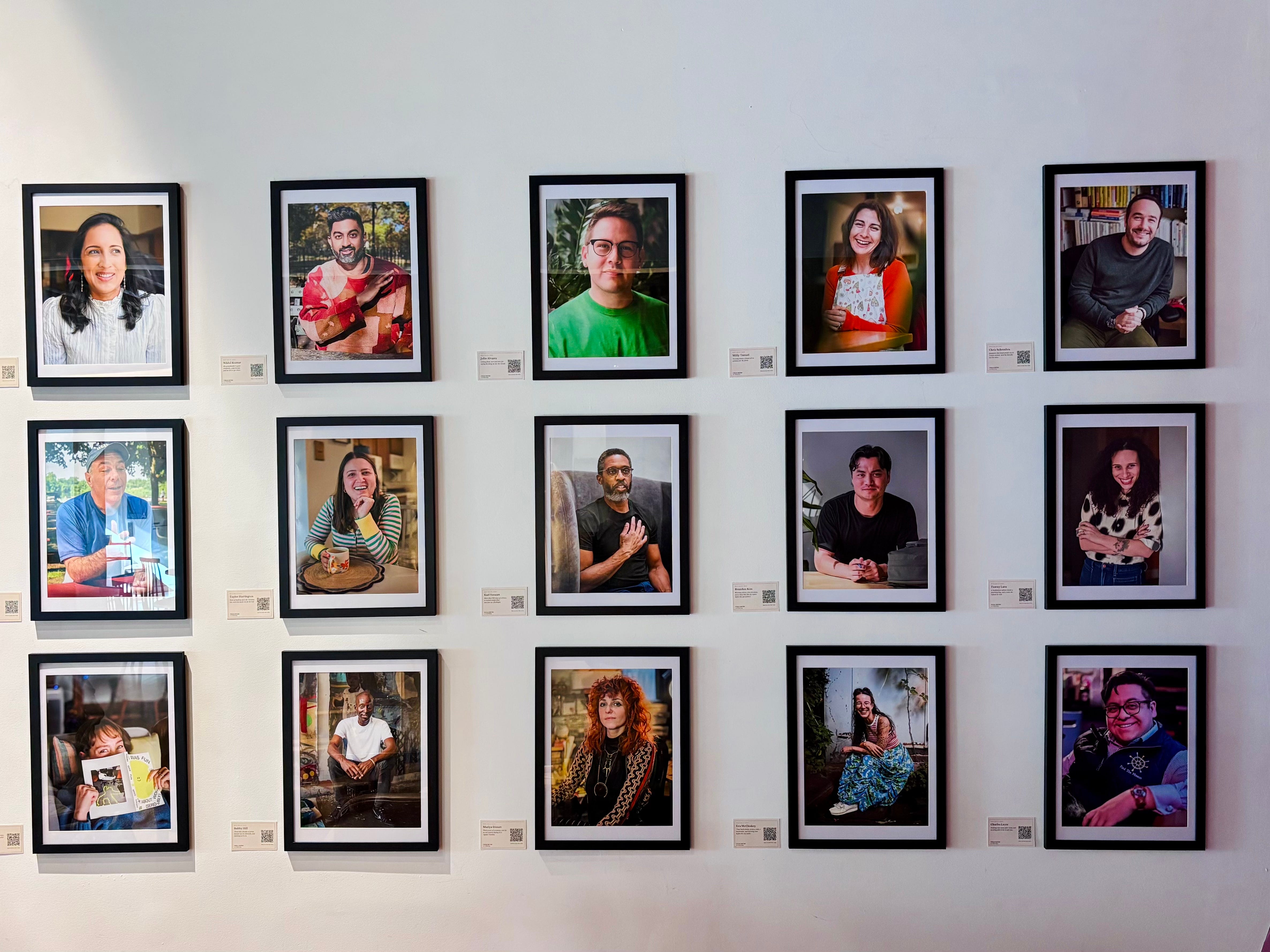
I look out at people I’ve known since I was born and people I met twenty minutes ago. Strangers are laughing with strangers. I overhear pieces of conversations about life, love, death, and travel. Everyone keeps saying we’re lonely and looking for meaning. Tonight, in this room, we found some.
I exhale. I’m smiling from ear to ear. Earlier today I was complaining about the new wrinkles on my face since my wife and I had the baby, and I know every second of this smiling is making more of them. I’m totally okay with it.
This is amazing.
I have one line ready for the end of my spiel: If you’d like to support this work, scan the QR code.
I never say it. I thank everyone, say a few words about unlearning, and wrap it up so they can get back to mingling. I don’t even notice. I’m too happy that everyone is here, together, in one room.
It clicks during cleanup. I’m trying to fit the leftover chips back in the bag, and it hits me. More than 35 people just walked past a wall of my work, and I gave the whole speech minus the one sentence that pays the mortgage.
At the end of the night I’m walking down the street with my best friend Joanne, kicking myself the whole way. I can’t keep doing this work if I don’t ask the fucking question.

So why didn’t I?
Because I learned a rule early, and I learned it well: make yourself useful, and maybe someday you’ll earn the right to ask for something. Until then, smile and work for free.
At fourteen I walk into the Warwick Beacon with a camera and an offer to work for free. They take it. By the time I graduate high school, my photos have run about a dozen times. I also shoot the entire yearbook. Total earnings: zero dollars. I thought the byline was the paycheck.


I learned it at home first. My dad leaves for construction work at 4:30 in the morning and comes home soaked in a day’s worth of sweat. My mom works nine to five in her fancy office clothes, comes home, and pours a glass of wine. Both of them sit on the couch only after they’ve earned it. “Well, I worked really hard,” my dad says, “so now I can chill out.” That’s the permission slip.
I love them. I watched them closely, and I learned exactly what they showed me: rest is a reward, and worth is something you produce. My mom and I talk about this now. She’s starting to get it. So am I.
My parents inherited this rule. My dad’s 4:30 alarm has roots in sixteenth-century Geneva. In 1905 the sociologist Max Weber traced the modern work ethic to Calvinist Protestants, who treated relentless work as a sign that God had chosen you.
So of course I never asked anyone to scan that QR code. The night felt easy. It felt like joy. And somewhere underneath, the rule was already doing the math: if it didn’t hurt, it couldn’t be worth anything.

Meanwhile, some people barely have to ask.
Take influencers. In 2025, brands in the US spent $37.1 billion paying creators to sell us stuff. The whole country gave $27.3 billion to arts and culture. That’s about $10 billion more for sponsored posts than for every arts and culture gift in America.
I have friends who are influencers. Some of them have made more off one gadget post than I’ve raised for Field Notes, ever. And plenty of those deals pay out whether the post lands or flops.
I’m happy for them. I am! Admittedly, it also pisses me off.
Tech is even better at it. Startups raise millions before they’ve finished building anything. A quick look at Pitch Deck Hunt shows you that you only need a few simple slides to secure multimillion-dollar deals. Some of the biggest brands we know today got started like that. (Some of the biggest scams, too.)
So how do they do it? They speak money’s language: views, clicks, sales, growth. An influencer promises eyeballs. A founder promises a hockey stick on a slide. Nobody has to prove anything yet. The promise comes in a language money understands, so the money goes out fast and freely.

But I don’t speak that language. This project doesn’t speak that language.
What can I promise?
Well, after our Field Notes session, the storyteller Matthew Dicks, a man who makes a living by teaching people how to find meaning, wrote: “You can spend your whole life trying to understand yourself and then a total stranger sees what you’ve missed all along.” I’ve watched that moment happen across a table more than fifty times. That return lands slowly, inside a person, and keeps paying out for years. Good luck fitting that into a pitch deck.
I call it the Two Economies of Work.
One is official, with titles and invoices and returns you can count by the quarter. The other is human: care, belonging, meaning, returns that compound over a lifetime. Most of us work in both and get paid for one. And when the human economy runs on volunteers, the volunteers run out. You can see it in the loneliness everyone keeps writing about. You can see it in me, too. Some part of me still files the work that matters most in the free column.
Ursula K. Le Guin has a story about this. I’ve read it so many times, and I cry nearly every time. In “The Carrier Bag Theory of Fiction”, she points out that we keep telling one story about where we came from: the hero with the spear, the kill, the triumph. It’s a great story, because you can count the kill. Meanwhile someone was carrying the bag, the actual sack or basket people used to gather food, which Le Guin calls “the tool that brings energy home.” Someone gathered the seeds and the roots and the herbs, made the medicine, fed everyone, and the story skipped right over her.
I cry because I know her.
She’s my mom. When I was growing up, she was the one carrying the bag. She made sure we always had healthy food in the house. She did all the laundry. She cleaned so much you could eat off our floors on any given day, and if people were coming over, forget about it. Immaculate.
And the worrying. My gosh. She’s worked in insurance her whole career, so the one-in-a-million chance of something blowing up or someone dying lands on her desk every day. Add that to her personality, and she worries about me and everyone else. Her job pays her for the worrying at work (not enough). Nobody pays her for the worrying at home.
All of it kept our family running. And all of it got skipped in the story, the same way Le Guin’s gatherer did.
She’s me, too. Ten months home with the baby, building this in the gaps. Standing at Fabrik, putting the chips back in the bag.

Which brings me back to money.
I love money. I want more of it. I want a roof, food on the table, and room to breathe for the people I love. Money is great. What we’ve been taught it’s for is the problem.
And the money exists. About $124 trillion will pass down through 2048, and around $18 trillion of it is headed to charity. MacKenzie Scott has given away $26.3 billion since 2019, mostly unrestricted and mostly without applications or reports. Trust first works at billionaire scale.
It works at regular-person scale, too. A handful of regular people looked at work from the human economy, the kind you can’t fit into a pitch deck, and paid for it like it counted.
The first patron of Field Notes is Juhi Kabra, an executive coach who finds me on LinkedIn after reading one of my Field Notes. We get coffee, and she asks me one question.
“What do you need?”
“Well,” I say. “I live in New York City.”
That afternoon I send her a menu of patron levels I made up in Notion, and she picks the $5,000 one. When it lands, I feel like a billionaire. (Five thousand dollars is real money. It’s also, technically, a fraction of a yacht.) It’s the first time anyone has paid for an idea that was only mine. Every other job I’d ever had came with a team, a client, a deliverable. Juhi paid for me.
That $5,000 covers my half of the mortgage, utilities, childcare and groceries. It buys me a minute to breathe and keep working without taking a full-time job. Then a friend of Juhi’s gives, because he knows she did. Then a tech investor I’ve never met answers a cold email with a yes. Then a retired professor calls me. Her gift pays for the first person I’ve ever hired onto this project, and the Field Notes are better because of her. You can see it in the work.
I’ve tried to fund Field Notes every way I know: about 40 grant applications, personal history sessions, paid Field Notes, corporate photography, thousands of DMs and emails asking for referrals.
Individual patrons have brought in about $40,000, more than all of it combined.
None of them asked for a hockey stick. They asked what I needed, and then they paid for it.
That’s the lesson I keep relearning. We pay for what we can count. The work that holds us together is the hardest thing to count, so it runs on volunteers until somebody decides to fund it on trust. Juhi decided. So did everyone who came after her.

So here they are, a few days late, with my full chest.
If you’d like to support this work, scan the QR code.
I’m going to keep doing this work either way. What changes is how much of it I can do. I see what it’s changing in the people around me, and in me. If I want my kids, and everyone else, to move through the world with hope and joy, then we have to have this reckoning about value and what’s valuable. Your support means I can do it without working another job on top of it. More of this work is what moves the needle. It’s also the cultural shift I want to see happen for all of us.
Online, the QR code is a link: Ko-fi, or The Field if you want it tax-deductible.
In 2027, every dollar takes Field Notes on the road: free living-room dinners in ten cities, where artists, legislators, founders, and neighbors sit at the same table, then Coffee & Conversation the next morning. No panels, no networking. One good question and a room of strangers. Put your city in the note. The first city to $10,000 gets the first dinner, on Friday, February 5. Right now Los Angeles leads with $1,100, Edinburgh has $300, and your city has zero. The race closes December 31.
Which economy do you believe in? And are your time and money flowing in that direction?
The antidote to loneliness is invitation. Consider yourself invited.
About Field Notes on Unlearning
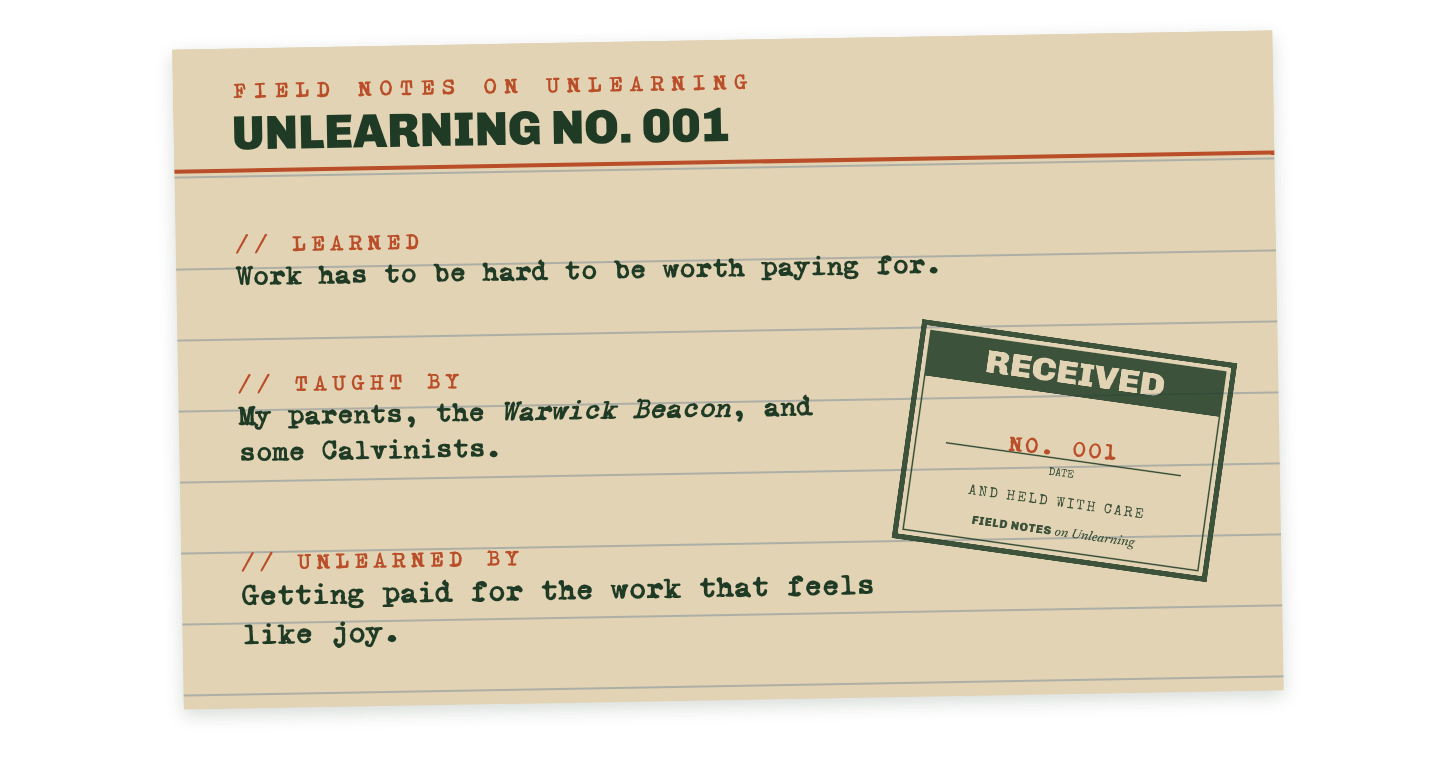
Field Notes on Unlearning is a record of unlearning, done together: essays, radio, and gatherings about the identities we carry, and what happens when we set them down. I’m Lindsey Lerner, and I host it. Every piece adds one entry to the public record of what we’re unlearning, and yours can go in it too. What was learned together is best unlearned together.
Sources
IAB, 2025 Creator Economy report, via eMarketer: $37.1 billion in US creator ad spend, 2025.
Giving USA 2026: $27.3 billion to arts and culture.
Pitch Deck Hunt: a library of real pitch decks from 100+ startups, from pre-seed to later stage.
Cerulli Associates, December 5, 2024: $124 trillion to transfer through 2048, $18 trillion to charity.
Fortune, December 11, 2025: MacKenzie Scott’s $26.3 billion since 2019.
Encyclopaedia Britannica, The Protestant Ethic and the Spirit of Capitalism: Max Weber, 1904–05.
Ursula K. Le Guin, “The Carrier Bag Theory of Fiction”: written 1986, collected in Dancing at the Edge of the World.


