




Press play. Or read along below.
Every kid at this lake is dreading September. One man here spent twenty-seven years counting the days to it.
He taught elementary school. Thirty of them coming through the door every fall, and he couldn’t wait.
He retired in June.
This is the first September of his adult life without a classroom waiting for him.
So he’s here on a Monday in August, with the drugstores already stocking backpacks and a dozen kids in orange vests zigzagging into the wind for their sailboat lessons.
The snack shack griddle heating up.
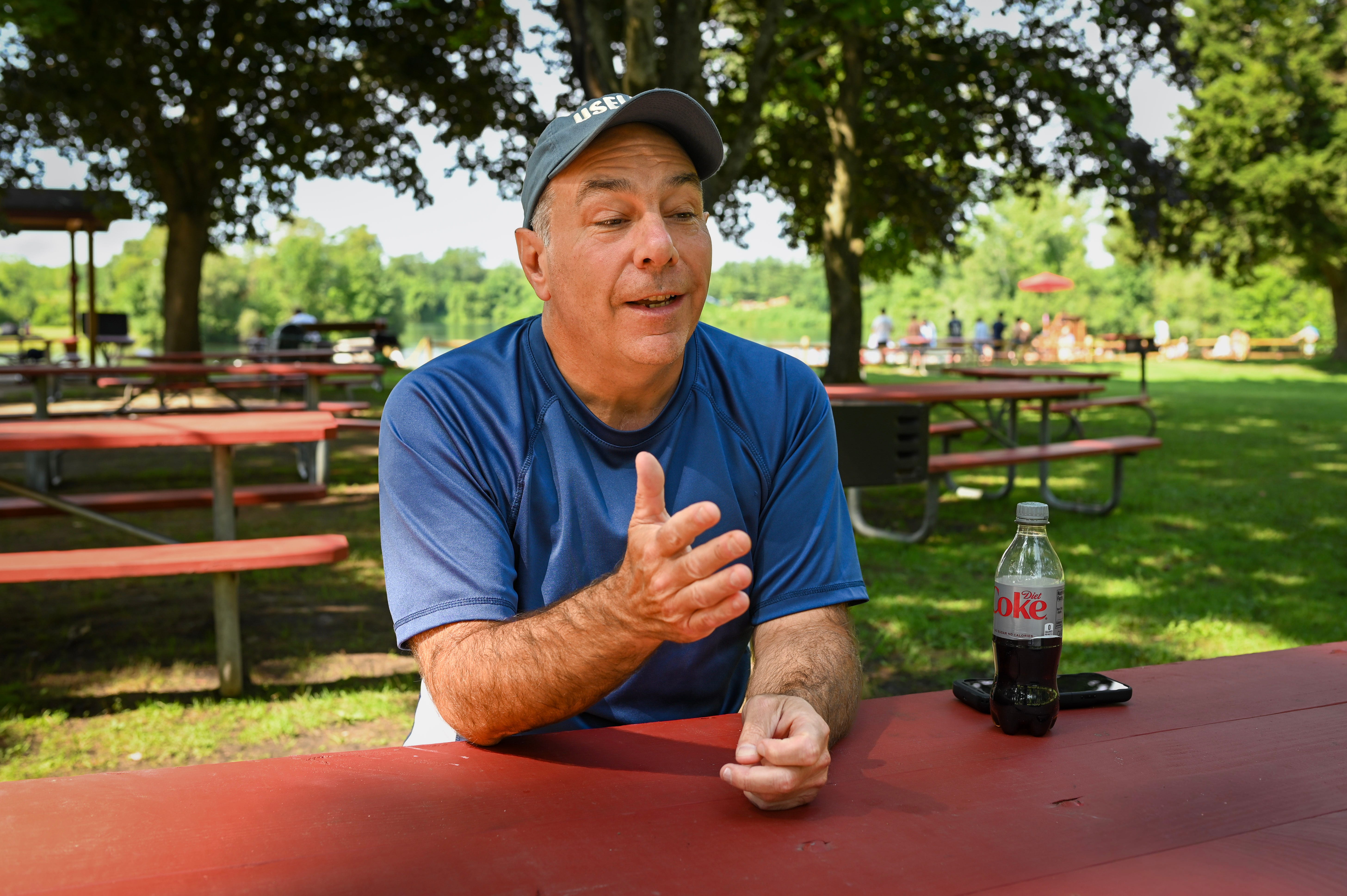
I sit down on one side of the picnic table. An absurd number of mosquitoes making a long breakfast of my legs underneath.
Across from me, Diet Coke already sweating a ring into the red wood, is Matthew Dicks.
I pick up the camera.
“Do your best to pretend I’m not taking pictures.”
“Yeah. Pretend you’re not taking pictures. Great.”
So that’s the working relationship.
Matthew Dicks does not care what you think of him.
The people who know him best all say the same thing. His wife calls it a blessing and a curse. His sister has never once known him to care.
I ask him where he feels most like himself.
“In a fight,” he says.
Then he tells me about the plane.
Fourth flight that week, ears shot. He’s reaching into the overhead bin when the plane lurches, he loses his balance, and the backpack on his shoulder swings around and catches the man in the seat below him square in the head.
He apologizes.
The man says no.
Just no.
“Now I’m in my happy place,” Matt says.
A stranger has just refused him in front of six rows of people. That’s a fight.
He gets close.
“You don’t have to be happy about it,” he tells the man. “You don’t have to think it was great.
But you have to know that I didn’t mean it, and I apologize.
That’s what I need from you right now.”
The man says fine.
Later the man kneels in the aisle and tells him American Airlines said to press charges.
Matt begs him to do it. Handcuffs. A courtroom. He’ll take any of it.
What he can’t take is being waved off.
The plane lands. He goes looking for the man, because he really did hit him and he wants to say it one more time.
The man walks off without looking at him.
The flight attendant waits until the guy is gone, then tells Matt he has a glass eye.
Matt hit the good one.
“This happens to me all the time,” he tells her.
It does, and there’s a reason.
Every night since 2012 he has written down the one moment that day changed for him. Five minutes, a few sentences. He calls it Homework for Life, and fourteen years of it have turned him into a man who notices everything that happens to him while it’s still happening.
So when a stranger kneels in an aisle at thirty-five thousand feet to threaten him, some part of Matt is already writing it down.
Then I notice what he asked that man for.
He let him stay angry. He let him think it was terrible. The only thing he needed was for the man to know he hadn’t meant it.
Every story is really an argument, he’d told me ten minutes earlier, and the ask is always the same one.
See me. Hear me. Understand me.
What he got was fine.
Everybody who knows him says he doesn’t care what you think.
But, e just told me about following a stranger up an aisle to get him to say more than fine.
I write it down and say nothing.
Hey, I’m Lindsey Lerner, and this is Field Notes from the Work (and the Wild). Unlearning, done together.
I sit with one person for hours and take their picture while they talk. 54 people so far.
Today’s story is about Matthew Dicks.
Yes, he was a teacher. But he also writes novels. He tells stories onstage and wins. Large companies pay him to fix their keynotes, which he does by sitting executives down and explaining that their work is bad, to their faces, in the voice he used on fifth graders.
It took me most of the day to work out what the fighting is for.
Four hours in, I said four words to him I’m still not sure I had the right to say.
He kept handing me evidence, one piece at a time, and all of it pointed somewhere else.
He’s a kid holding up a report card full of A’s. You want to see it?
Nobody wants to see it.
“I still have them,” Matt tells me. “They’re in my file cabinet in my house. I’m keeping them in case you ever want to look.”
His parents never watch him pole vault. He’s a state champion. Six years in a marching band that wins New England twice, and they never hear him play a drum.
So he keeps the report cards. He posts his goals on the internet, every year for sixteen years, updated monthly, with the misses left in where anybody can count them. The nightly entries go in the same drawer.
And his greatest joy, he tells me, is the second a loud room goes silent because of something he said.
“I revel in the joy that I made them do that. I made 500 people all do the same thing at the same moment. And they didn’t know I was trying.”
It lasts three seconds. Then he does it again the next night.
He went out and found the witness himself, and got them to pay for the privilege. Most people get one for free. It’s called a parent.
Two hours in, I’ve got a pattern and no idea what to do with it.
So I ask him what’s next, and what scares him about it.
A fringe festival. Solo show, two weeks, a city where nobody knows his name. Twenty-seven years in front of fifth graders, hundreds of nights on a stage, and this is the thing that gets him.
I ask if the fear is what people will think.
“That’s not my fear,” he says. “I don’t care what people think.”
A breath.
“As much as I don’t care what people think, I definitely don’t want to perform to two people.”
Judgment, he can take.
Going unseen, he cannot.
That’s what the fighting is for. A fight is two people paying attention to each other.
There it is, out loud, and he doesn’t appear to notice he said it.
I don’t say anything about it. He notices that, too.
“So what’s your greatest joy?” he asks me.
“Mmm,” I say. Then I tell him some people think I should sit for one of these myself.
“That’s deflection of what other people have said,” he says, “and not an interpretation of how you feel about it. For the record.”
He waits.
“I’m really good at watching people deflect.”
Nobody gets that good at it by accident.
He can turn anything that happens to him into a story. There are two he can barely tell.
He’s a high school senior, about to be put out of his house with nowhere to go. He and his friend Bengi are sitting in a bulldozer at a construction site for a Stop & Shop, because that’s where they hang out, and Bengi asks if he wants to live together.
“He has no idea,” Matt says, “probably even to this day, how I had to hold back the tears to think I might have a place to live.”
Thirty-some years later, Bengi is the reason Matt lives in Connecticut. Bengi still doesn’t know what that question did.
Then he tells me about the night before I showed up. They’re driving home from a comedy show and Elysha, his wife, asks what his favorite part was.
“This sounds so stupid, and I’m not trying to hit on you right now. But I just love to listen to you laugh.”
He had been looking over at her all night, just to hear it.
Bengi has never heard his. Elysha got hers after two apologies.
Five hundred people in the dark is the easy room.
The hard one has two chairs in it.
I ask him how he got this way.
On a greasy tile floor in a McDonald’s, 1993, three men put a gun to his head, count down from three, and pull the trigger. The chamber is empty. He finds that out afterward.
Over and over.
Years later a therapist who works with Vietnam veterans tells him tapping could clear the PTSD completely.
He goes home and asks his wife if he should do it.
She says no.
Lose the edge, she tells him, and you’ll become like one of us.
He agrees with her. He wakes up excited every morning that he woke up at all.
So he keeps it. And the edge goes all the way back.
Late in the afternoon we get back to the fighting, and where it started, and he lands on his stepfather. A combative man. A whole childhood of fights lost at the dinner table.
“Boy, I learned how to fight,” he says. “I remember all the fights I lost against him and how frustrating it was. So I just worked really hard to —”
He’s looking for the end of the sentence.
And I have it. I’ve had it for an hour.
“Never feel like it,” I say.
And what I feel is calm. Solid. Like the sentence was already sitting on the table and all I did was read it out.
Then the heat comes up the back of my neck, and the voice I’ve had since I was a kid at my own parents’ table.
You did not need to say that.
“Yeah. Yeah,” Matt says. “Wow. That’s true. I spent my whole damn life trying not to feel like I felt at the dining room table. I just had a moment.”
He has landed there once before, in Brazil, a few years ago. Two thousand kids in an auditorium, a girl stands up and asks why he puts all of himself into the world.
He hears himself answer that he’s trying to get the attention of a mother who’s dead and a father who never looked in his direction.
And in the next breath: “Okay. It’s pretty good.”
He graded it.
“It’s a story I’ll tell someday now.”
He filed it.
And once more, like a man signing a form: “That’s okay, though. That’s pretty good.”
Ten seconds, from the rawest thing in him to material.
He tells me about his mother. She died in 2007.
His father went in and out after the divorce, when Matt was seven. Mostly out.
When somebody dies, he says, the hard drive crashes. Every question you ever wanted to ask goes down with it.
He knows nothing about the day he was born. Not the hour, not the weather. The woman who knew is gone and the man who might remember won’t talk to him.
The night his daughter was born he sat down and wrote fourteen pages about what the day was like, so she would know.
Late in the day we trade the picnic table for paddleboards.
Two people in the middle of a lake, having a conversation about work and parents and what any of it is for.
Water moving under us, both of us working to stay upright, both of us saying true things out loud while we do it. We’re all just out there paddleboarding, trying to stay upright, doing our best.
He found what he’s running toward in front of two thousand kids in Brazil.
He found what he’s running from at a picnic table with one person and a camera.
Fourteen years of nightly entries. Sixteen years of public goals. A file cabinet, a blog, a book, a stage. All of that machinery, and both times the thing he most needed to know came out of him because somebody else was sitting there asking.
Somebody finally looked, Matt. The grades were the least interesting thing in there.
Now, as always, a practice for you.
Everybody you love is a hard drive. The day comes when it stops spinning and every question you meant to ask goes down with it.
A Practice in Keeping the Record.
Notice whose questions you still have time to ask. Pick one person.
Name the thing you’d want to know if they were gone tomorrow. Write the question down, because it will vanish in the moment.
Ask it this week, and write down what they say. On paper, in your own hand.
Then do the other half. Write down a day somebody will want back someday.
Thank you, Matt, for the day, the ginger ale (because yes, I’m an old lady), and every question you answered.
Until next time.
Stop fixing. Start flowing. See you in the next Field Note.
P.S. Field Notes exists because people showed up — at events, as patrons, as subscribers. The next event is November 3rd at Fabrik in Tribeca!


