

“I know English caused you some tears, but instead of falling apart, you worked even harder. You never whined.”
That’s my tenth-grade English teacher, writing in my yearbook, praising me for not crying where anyone could see it.
My parents brought the yearbooks back a couple weeks ago. I hadn’t seen them in years — didn’t know they’d kept them. His handwriting is cramped into the margin because he had too much to say to fit next to his picture. The rest of it: Rather, you came and got the help you needed. The result is that you are a much stronger writer and I think stronger person as well.
I remember which paper he means.
Tenth grade English. Second row from the front, right side of the room — I couldn’t tell you why that seat, just that it was mine.
I know what I want to say. When I say it out loud, he understands me immediately. But saying it doesn’t count. It has to be written down, and it has to be good, every source cited, formatted exactly to OWL at Purdue or it doesn’t exist. I never let myself get emotional in class, so if I need to fall apart, I do it after the bell, or at department night, where the room is nearly empty and it’s just him.
I walk in to hand him the paper and my body starts before I do. Heart racing. Sweat forming at my hairline, sliding down the small of my back.
I hand it over. My chest tightens while I wait.
The red pen comes out. I look away — I can’t watch this part, it’s like watching someone get operated on.
When I look up, all I see is red. More ink than my own words.
“It’s fine,” he says. “But I know you can do better.”
The heat starts in my chest and climbs until it’s behind my eyes. I feel them start to sting. I don’t let it go further than that.
“I’ll work on it,” I say, and take the paper back.
He operated in red. I go home and open the same incision myself — read it again, and again, find more sources, sit with the same six sentences until they’re not the same six sentences anymore. By the fourth draft I’m the one crossing my own words out, harder than he ever did, tighter, uglier.
I hand in the final draft and it comes back with an A+. The sharp thing that had been sitting behind my right eye for days finally lets go. My shoulders drop out of my ears and back into place.
The grade wasn’t the point. Being the kind of kid who gets that grade was.
Then, before my shoulders even finish dropping, I’m flipping to the next assignment in my planner, checking what’s due after this.
I close the memory before I close the book. Flip forward.
My art teacher: “You were always so helpful to me and so creative.”
My science teacher: “You are a great kid.”
My history teacher: “You were always a big help in student council.”
A math teacher I can barely picture anymore: “I know you will be successful in all that you do.”
My guidance counselor: “Please stay motivated to accomplish all your goals.”
Helpful. Great kid. Big help. Successful. Motivated. Every signature, every year, same shape.
Nobody signed my yearbook “I hope you rest.”
I’m ten and I’ve got a light blue Red Sox hat on, backwards. Permanently affixed. I barely remember it coming off, even for sleep. I know it doesn’t thrill most people, but it makes me feel comfortable, so fuck ‘em.
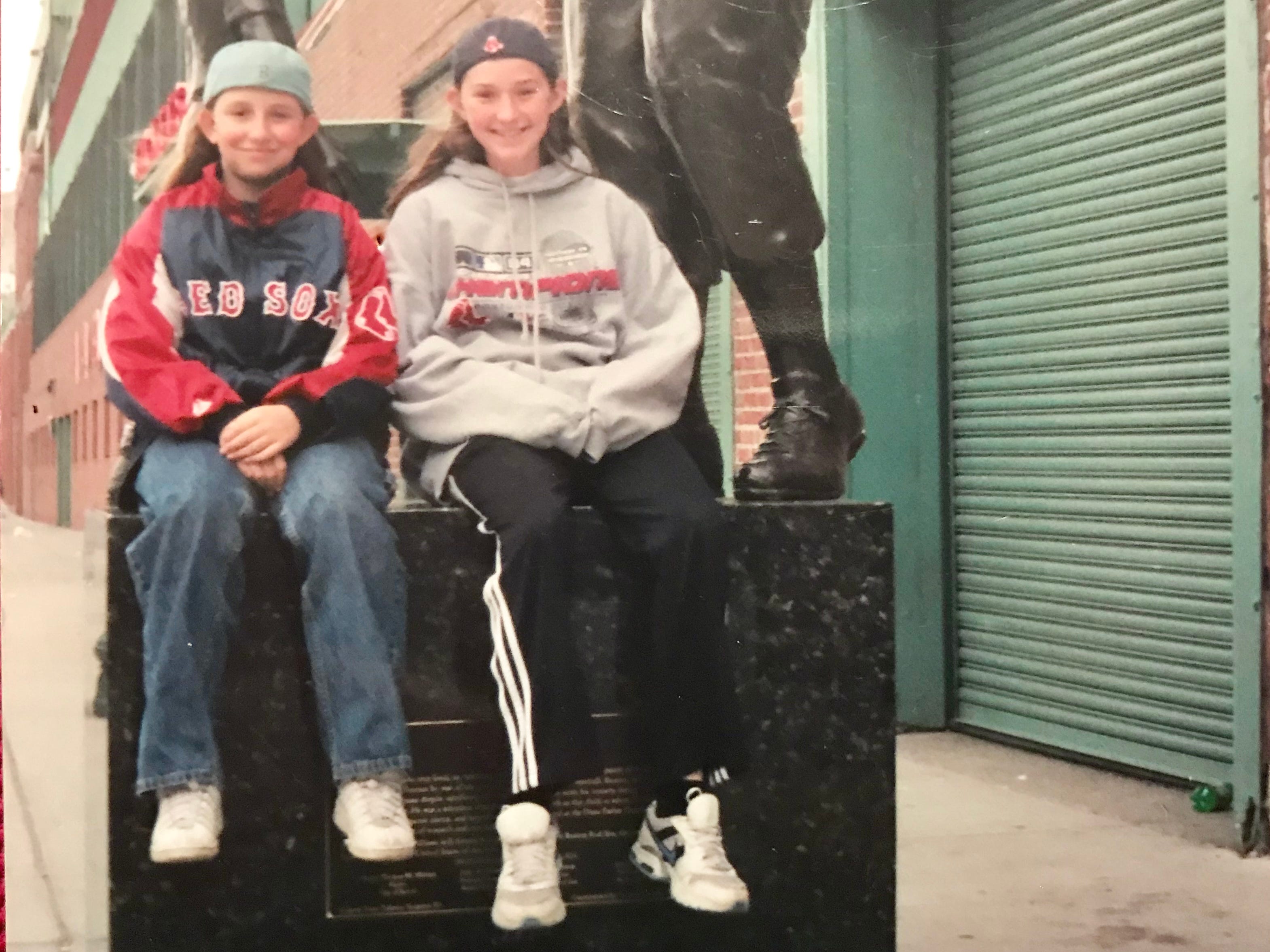
By ten I’m good at doing what I’m told. I say please and thank you without being reminded, I don’t make noise in restaurants, I’m the one the adults say is easy. The hat is the one thing I won’t hand over.
We’re at Chelo’s, Rhode Island’s very own chain restaurant — think Applebee’s, but the food’s better. My grandmother and step-grandfather are regulars here and get treated that way. It’s me, them, and my two little cousins, three and five years younger than me.
They put us at a semi-private table up on a raised platform where you can see nearly the whole restaurant.
“Lindsey, take your hat off.”
I have selective hearing, and I select not to hear that.
“Lindsey, take your hat off.”
I don’t know where it comes from. “No.”
His fist comes down on the table. The silverware rattles. I watch the water shiver in the glasses. Every head on the floor turns around to find us.
I take the hat off. My hair is matted and molded to my forehead. My face is scorching. Every muscle from my shoulders to the base of my skull locks up. My throat is choking itself, or maybe I’ve bitten my tongue off and I’m choking on that.
The hat is where I hide. He just took it off me in front of the whole restaurant and a plate of mozzarella sticks.
My cousins are crying. They just found out what happens when somebody doesn’t do what they’re told.
We’re told to sit down and stop crying.
We eat. We leave. The hat is back on before we’re out the door.
Hats and hoodies for years after that. I liked how much of me they covered.
That was the last time I said no and meant it.
It takes me 23 years to take the hat off on purpose.
I’m at my desk working on Maricela Herrera’s Field Note, and the muscle from my shoulder to my fingertips tightens when I start putting my perspective into a story that’s supposed to be about someone else.
Maricela spent eleven years inside a company where people said its name instead of hers. When she left, she went home to El Salvador and found every journal she’d kept since she was a girl. She tore out every page and tore each one apart before she threw it into a fire.
I’ve never torn anything before burning it. I go straight for the fire. I don’t know yet if that’s faster or if it’s just easier.
I knew it had to go in. I also thought Maricela would read it and think I’d made her story about me. There’s a cramp in my middle knuckle, like I’ve flipped off too many people, and it locks as I go to hit publish.
I publish it anyway.
Two days later a message comes in: So proud of you, dude. Every time I read or hear something from you, it is more distinctly YOU.
Someone who knows me well is telling me my story counts. I haven’t decided that yet, so I can’t take it from her.
The car is boiling. I’m on the subway to an event, and I’m a nervous sweater, so the heat and the nerves stack on top of each other and I’m already losing.
I open my email.

My eyes bulge. I wait for the doors, jump out onto the platform, sweating through everything, and call my wife.
“BABE! I’m getting 10K for Field Notes!”
She’s stunned. “Really? That’s amazing!”
“FUCK YEAH! OF COURSE I AM!”
The venue is three blocks away. By the time I get there, the swagger is gone and I’m already planning what I have to do to prove I deserve the money.
My wife and I are at our Thai place in El Barrio. The service is unusually slow.
Normally this is where I’d start asking her questions. Seven years and she’s never wanted anything from me. I don’t have to do a thing and she’d love me anyway, which I still find confusing. So I go looking for the thing to be useful about — how was the day, how’s the job hunt, what happened with that thing — enough of them, fast enough, until we land on something she wants to talk about and I can settle in.
Instead I tell her that in seven years I’ve never asked what she thinks of my writing. That she’s a better writer than I am, and I’ve kept the question shut because a real answer could take something from me.
She puts her fork down. “I never said that. No one ever said that.”
I keep going. I tell her she’s one of maybe three people whose opinion I care about, so I’ve spent years assuming my work doesn’t hold up in her eyes.
“I think you are a very good writer. I respect you tremendously, that is why I’m married to you.”
“This is the first I’m hearing.”
The food comes. She asks if I want to get drinks or ice cream after.
Somebody asks me for something and the fix shows up before they finish the sentence. Still does. Every time.
My English teacher never knew about the other three drafts. Maricela has no idea what I almost took out. The guy who sent the money is out there living his life, and I’m the only one who knows he charged me nothing and I paid anyway.
Nobody asked me for any of it. I just kept handing it over.
Now I sit there with my hands in my lap and let the silence sit.
Most of the time.


