

Draft Twenty-Eight
On draft twenty-eight of my TEDx Princeton talk, I drove to my friend Drew’s studio believing I was refining something strong.
We had already spent hours in that room pushing on ideas, recording his Field Note, trading frameworks back and forth. Instruments lined the walls, guitars leaned casually against amps. The room held energy. It felt like a place where truth either sharpened or collapsed.
I handed him the draft and watched him read.
I had already secured the TEDx Princeton invitation. I had filmed the five-to-seven-minute application video. In my mind, I was polishing.
He finished, looked up, and said, “This isn’t it, dude.”
Then he reminded me that I had already written the essay: Why Doesn’t Success Feel Like Enough?
“That’s the talk,” he said.
I felt recognition before embarrassment. I had written the idea that mattered to me. Then I dressed it up. I made it bigger, more stage-worthy, more “TED” — as if the stage needed impressing rather than inhabiting.
Draft twenty-eight exposed it: I still believed the stage required something other than myself.
The First Time I Saw the Red Dot
When I was sixteen, I watched Sarah Kay’s TED talk in my childhood bedroom. I replayed it over and over, studying how a theater leaned toward her without her asking it to.
I didn’t crave attention. I craved alignment — the feeling of saying something so precise it lands.
I attached meaning to the red dot. It meant legitimacy, arrival, permission. The whole mythology of being chosen.
So I moved closer to it in every way except standing on it.
Building Stages for Other People
In 2018 I volunteered for TEDxProvidence and helped book Raquel Rodriguez — someone I had tour managed and watched grind in rooms that barely knew her name. The following year, Big Lux. Then Monika Sattler, who would go on to bike 3,000 kilometers of the Vuelta a España and 124 Swiss mountain passes in 26 days. I loved building the container. I was good at it. Dangerously good at it, in the way that keeps you useful and off the stage.
Eventually, good at it stopped being enough.
The Prep: December 2024
I started working with Tessa Rawson in December 2024, almost a full year before Princeton said yes.
At that point, I didn’t have a draft. I had a pressure in my body — a low, steady hum that something about the way we define work, worth, and success felt distorted. I had been circling that realization for years, writing around it, building projects around it, photographing it in other people. I just hadn’t planted my feet inside it.
I told her I wanted a TEDx stage in 2025.
I said it cleanly, like a goal you write on a whiteboard. One of those goals that sounds straightforward until someone asks you a real question about it.
She didn’t ask about the stage. She asked which idea I was willing to defend in front of hundreds of people.
That question slowed me down.
I started talking. I talked about how we elevate the visible performer and overlook the people quietly holding systems together — the ones who never get named in the highlight reel. I talked about HR filters that erase people whose career paths refuse to move in straight lines. I talked about AI replacing labor while leaving meaning untouched. I talked about billionaires writing about “never enough” while essential workers quietly keep cities running. I talked about the ache that follows achievement — how we’re trained from childhood to believe the next milestone will finally settle something inside us.
I wasn’t short on conviction.
I was w i d e.
She listened and began organizing what I poured out.
Then she asked me three questions:
What problem do you see?
What are you offering in response?
What changes if people believe you?
The questions exposed something uncomfortable: I cared about all of it. Every thread connected and it all felt urgent. Turns out that is not a talk. That is a breakdown with citations.
She kept bringing me back to one thing.
If you have ten minutes, where do you stand?
I realized I wasn’t wrestling with clarity. I was wrestling with choice. Choosing one edge meant letting the others stand without me defending them. Breadth felt powerful, but committing to a single idea felt exposed.
I didn’t have a talk.
I had a manifesto.
Drew would later say the same thing in his studio.
A TEDx talk requires a single blade.
Working with Tessa didn’t hand me a finished script. It handed me a mirror. If I wanted the stage, I would have to choose one idea and stand inside it — without hiding behind everything else I also knew.
That narrowing became the real preparation.
Ten Applications and a Hometown Rejection
In 2025, I applied to ten TEDx events.
I had worked through Tessa’s TEDx Application Kit.
Each application required the same discipline: distill the idea into five minutes, record the video, watch it back, and listen for where I drifted into abstraction instead of standing inside the core question. The process exposed the places where I leaned on language to sound expansive instead of precise. It revealed where the idea carried weight and where it dissolved under pressure.
The applications became rehearsal.
Four rejections arrived.
Brown carried a different charge because it was in my hometown. The theme was “Don’t Blink.” I could picture the stage. I could feel what it would mean to stand there and offer something back to the place that shaped me.
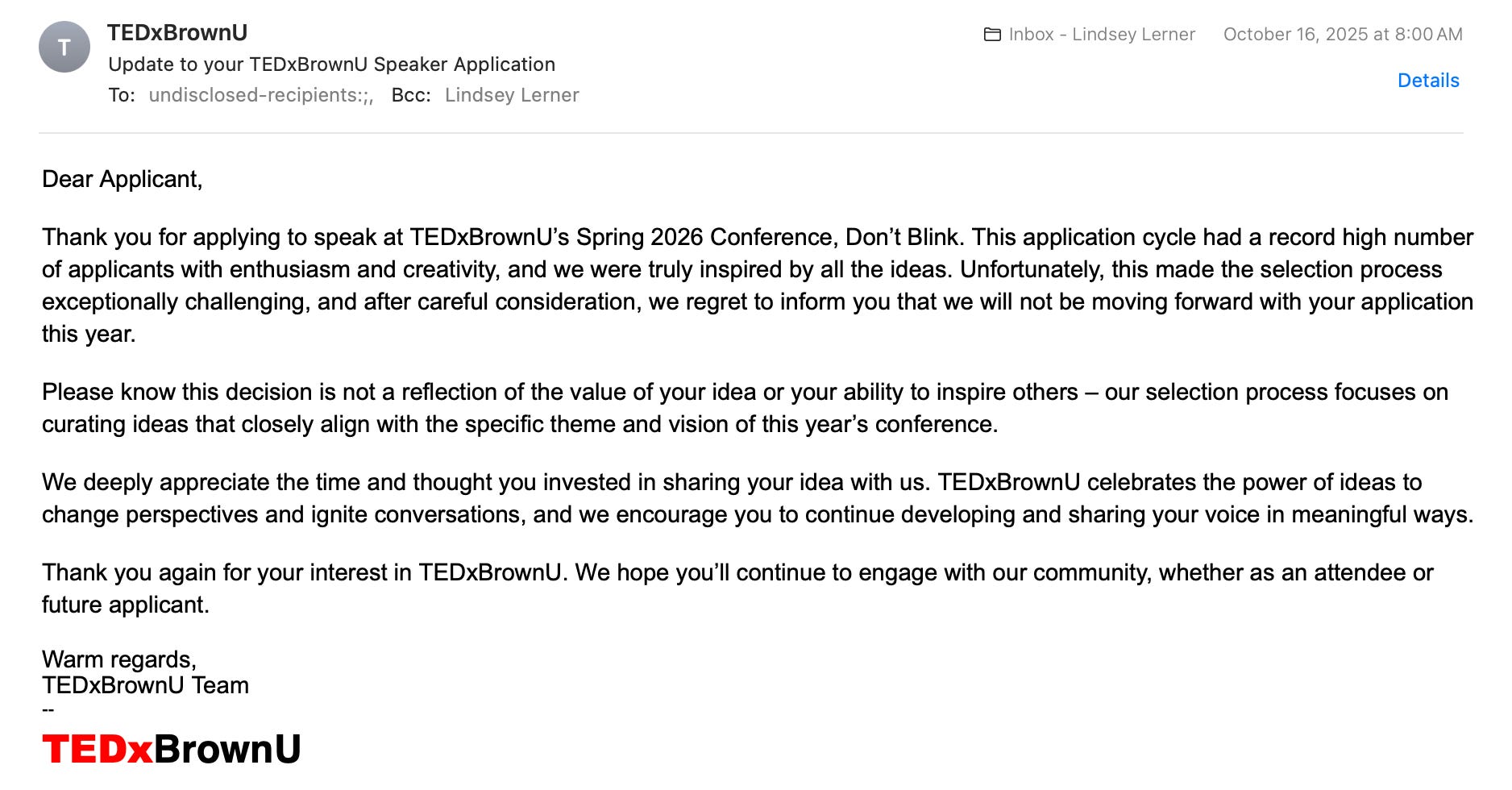
When the email arrived — “we will not be moving forward with your application this year” — the disappointment landed quietly and deeply. It felt personal in a way the others did not. I had invested in coaching. I had narrowed the idea. I had done the work. The answer was still no, and it still stung in the specific way that hometown rejections sting — like being overlooked by someone who should already know you.
That moment clarified the role of the applications in my process.
Each submission forced me to choose. Every rejection asked the same internal question: Will you keep refining this idea because you believe it matters, or will you wait for permission to continue shaping it?
I kept shaping it.
By the time I got a yes, the idea had already been chosen. The work of becoming had already begun through repetition, narrowing, and commitment. The acceptance confirmed something visible. The applications had already done the invisible work.
November 4: The Email
On November 4, I finished my Field Note with Nikhil Kumar and stepped into a small coffee shop in lower Manhattan. Election day energy pulsed through the city. My body carried hope in multiple directions.
I opened my email.
“Congratulations — You’ve Been Selected to Speak at TEDx Princeton 2026.”
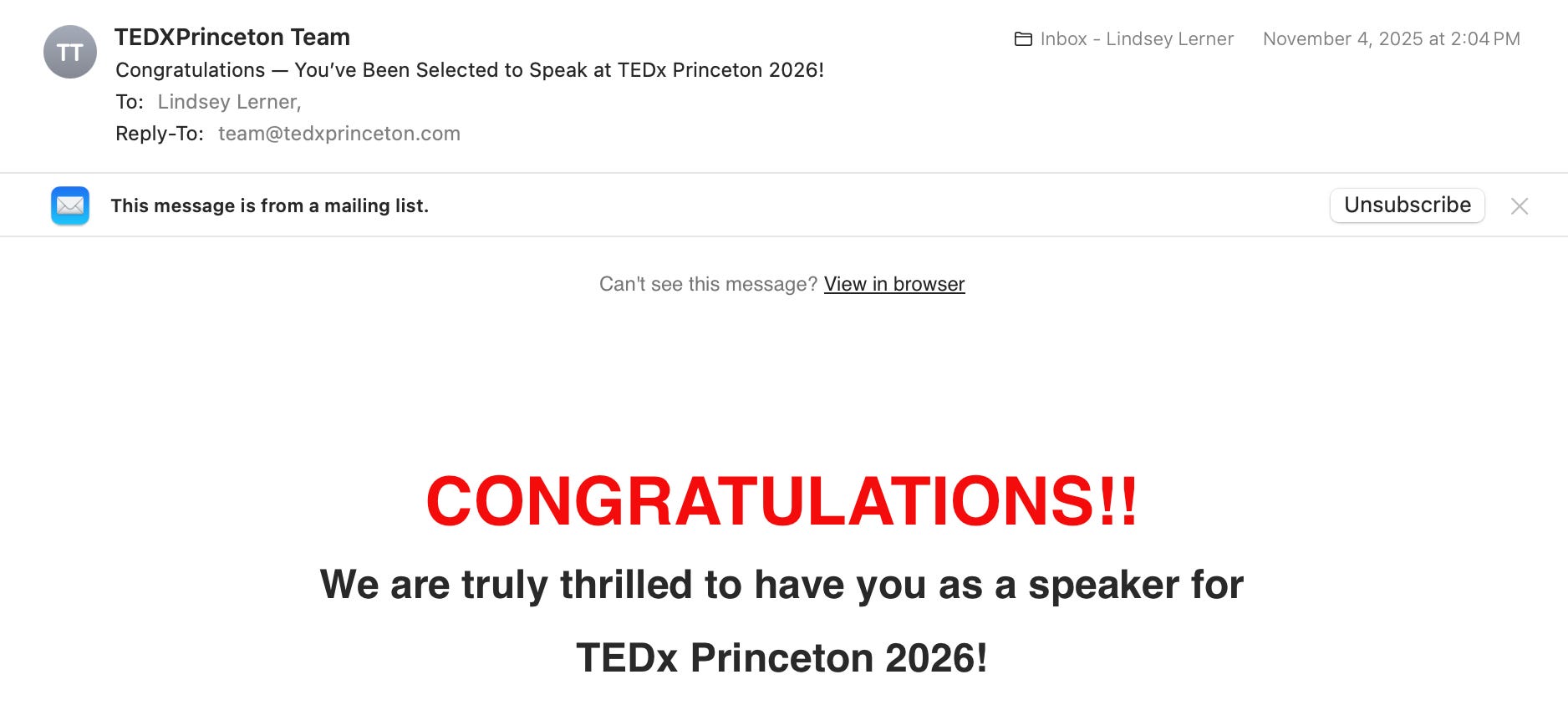
I danced in that coffee shop. Andee Scarantino happened to be there — the same space where I had photographed her Field Note. The moment folded in on itself.
On the subway ride home, I cried.
Then I scrolled down and saw the date: February 5.
The celebration turned into a calendar. There was work to do.
Thirty-Three Drafts
When the acceptance email arrived, I felt relief. Being selected created the illusion that the hardest part was over. The invitation actually raised the stakes. The idea now had to carry a room.
I wrote thirty-three drafts.
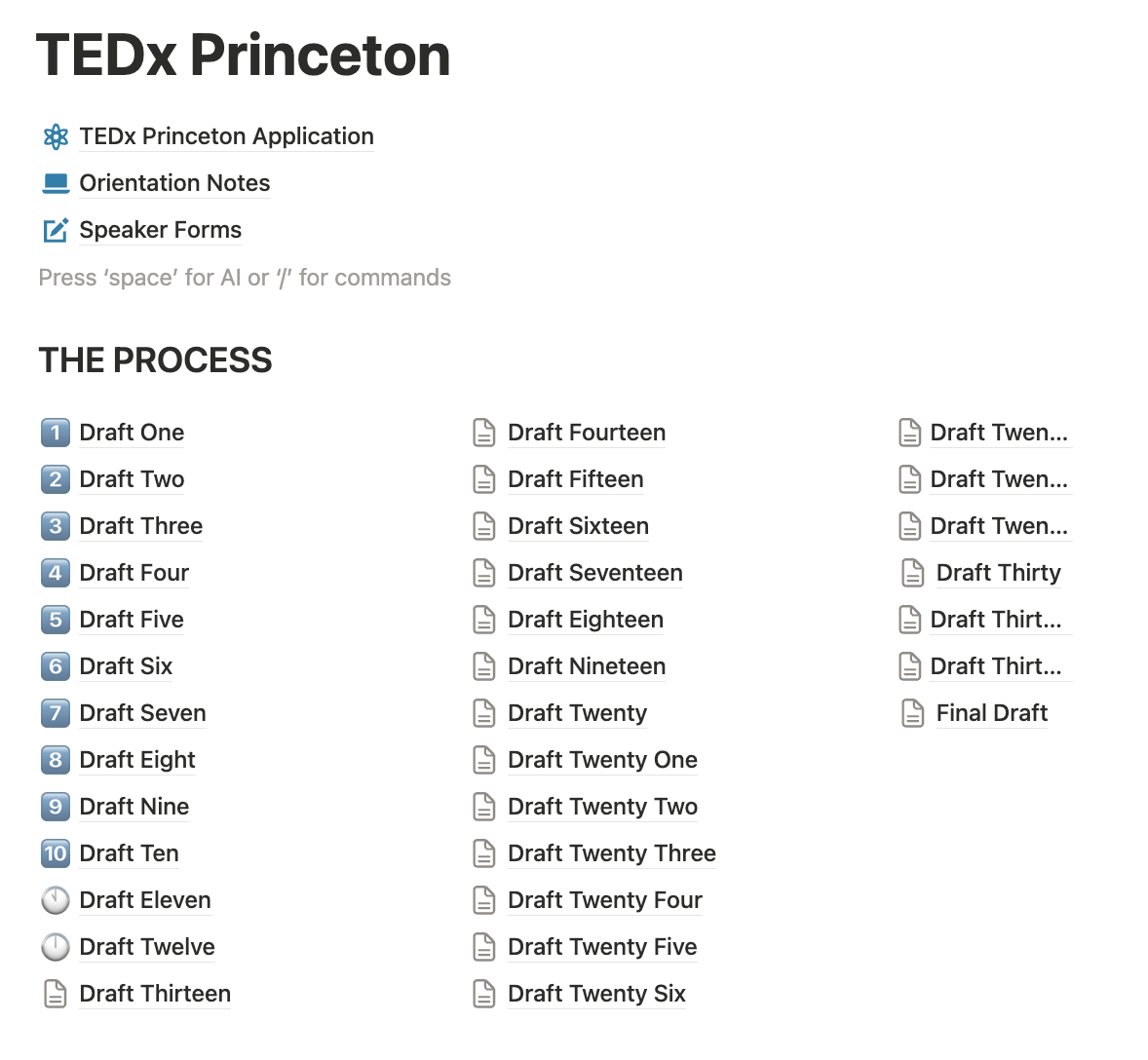
I wrote them while raising a newborn. I wrote them between feedings, between school drop-offs for our older daughter. I wrote them in a house that did not care that I had a TEDx talk to prepare. Not even a little.
The early versions were polished and expansive. I drew from anthropology, labor economics, productivity culture, and technology. The frameworks were tight. The metaphors were sharp. The argument sounded intelligent and comprehensive. I could feel how impressive it made me sound, which was exactly the problem.
Each revision removed something I had been hiding behind. A metaphor that softened the edge. A paragraph I loved because it showcased range. A section that made me sound informed instead of exposed.
I sent one draft to my friend Joanne. She returned it with more than fifty comments (FIFTY!) circling the same instruction: “Be more honest.”
I wanted someone to say this is impressive. Instead, she kept steering me back to something simpler and harder.
Where are you in this?
That question hit differently when I was writing on four hours of sleep with a newborn strapped to my chest. I saw how often I relied on analysis to protect myself. I saw how tempting it was to hide inside ideas instead of stand inside experience.
By draft thirty-three, I wasn’t refining language. I was stripping away protection.
Securing the stage did not finish the work. It exposed how much of myself I still needed to choose — even when I was tired, even when my house was loud, even when part of me wondered whether this was indulgent or necessary. It probably was both. Most things worth doing are.
February 5: When the Words Left
My parents flew up for the talk. My nine-year-old had been rehearsing with me for months and could have delivered it herself. At home, a newborn dictated the rhythm of our nights. Sleep came in fragments. My body still felt like it belonged to someone else.
The night before, Shoshanna, our organizer, hosted dinner so we could sit around a table and remember that this was about people, not production value.
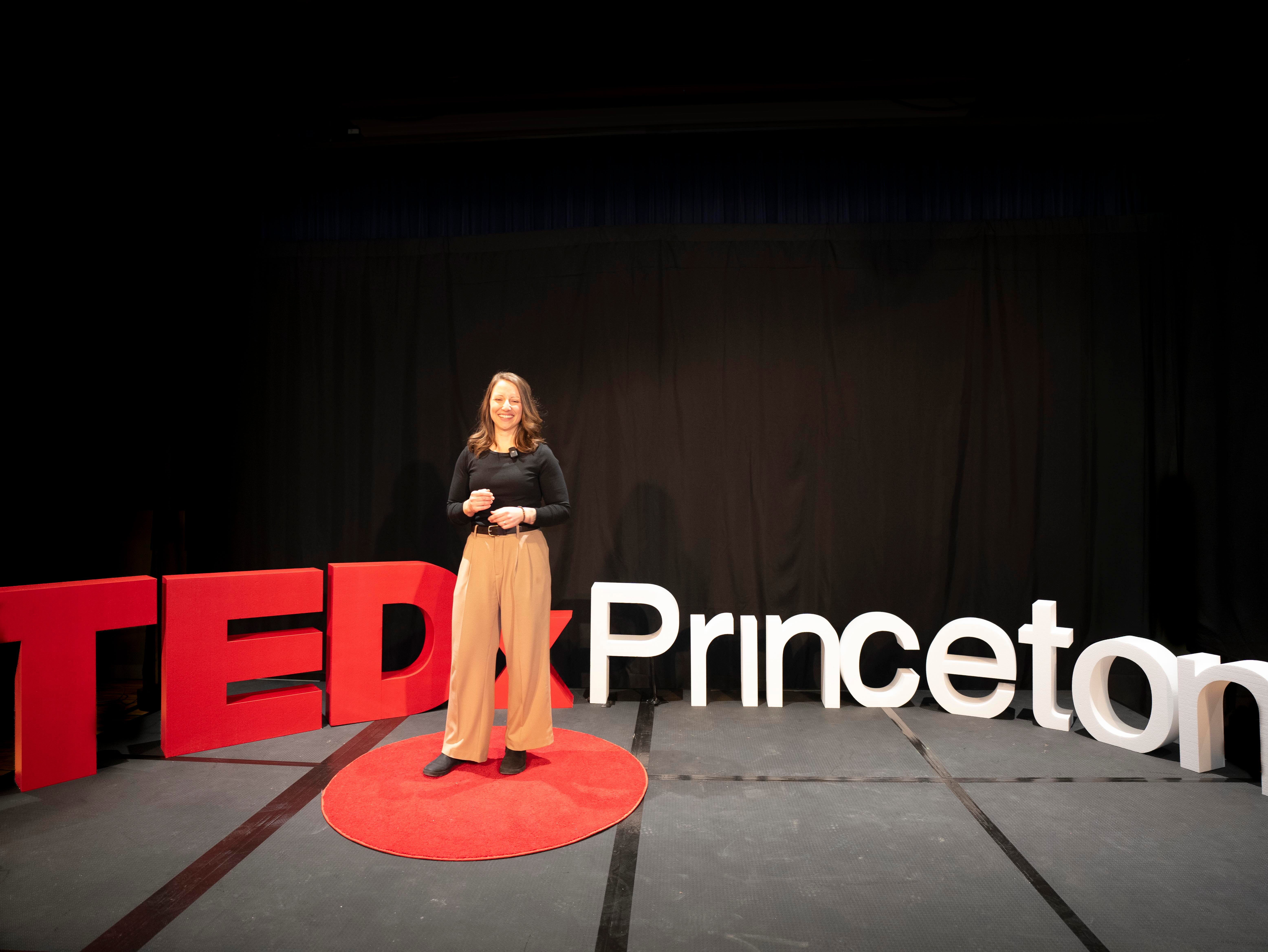
When I walked onto the stage, I felt steady. The talk had moved from memorized to embodied. I had said it pacing barefoot while rocking a baby. I had said it into my phone camera during nap windows. I had said it while reheating coffee I forgot to drink. The talk knew me better than I knew it.
About five minutes in, I locked eyes with someone in the audience.
They were crying.
Seeing that shifted something in the room. The words stopped being ideas and became impact. And then I completely lost my place.
I forgot the sentence. The next line disappeared. I stood there under bright lights and the script in my head was gone.
So I stopped. I stepped off the red dot and walked off the stage where my printed script sat. I found my place. I restarted at the top of the sentence.
A few minutes later, it happened again.
I had never felt more grounded.
There was no spiral, no frantic scrambling to protect my image. I could feel the discomfort in my body and stay with it. I could feel the room and not shrink. The months of drafts, the rejection emails, the coaching calls, the rehearsal in my living room with a baby on my hip — all of that work before the work showed up right there.
The irony was sharp and almost funny. I was giving a talk about the messy middle, about success and enough, about the invisible labor that shapes us long before anyone sees it. And I was standing in the mess in real time, choosing to continue.
I walked back to the red dot.
I finished the talk.
Afterward, a woman hugged me and thanked me for continuing. In the elevator, a man told me he was walking through something heavy and that watching me stay steady mattered to him, told me that he would keep going.
When I watched the edited version later, the disruption barely registered. The cuts are clean. The pauses look intentional. The moment that felt enormous became almost invisible. That is the cruelest and most clarifying thing about performance: the thing that breaks you open on the inside reads as a graceful pause on the outside.
That night at dinner, mascara running down my face, I let the pressure move through me. I cared deeply about that talk. I cared about my daughter seeing me handle discomfort without flinching. I cared about proving to myself that I could lose the words and keep the ground. That was the invisible work — not the drafts or the applications or the coaching calls, but the moment I decided the ground was mine to stand on.
The stage is visible.
The becoming is the moment you forget your place and discover that you can stay.
February 6: A Different Weight
I didn’t expect to test that lesson again the very next day.
On January 8, I learned I would be speaking at TEDx SUNY New Paltz the day after Princeton. After years of chasing one stage, I somehow ended up with two in forty-eight hours. The universe has a sense of humor and it is not subtle.
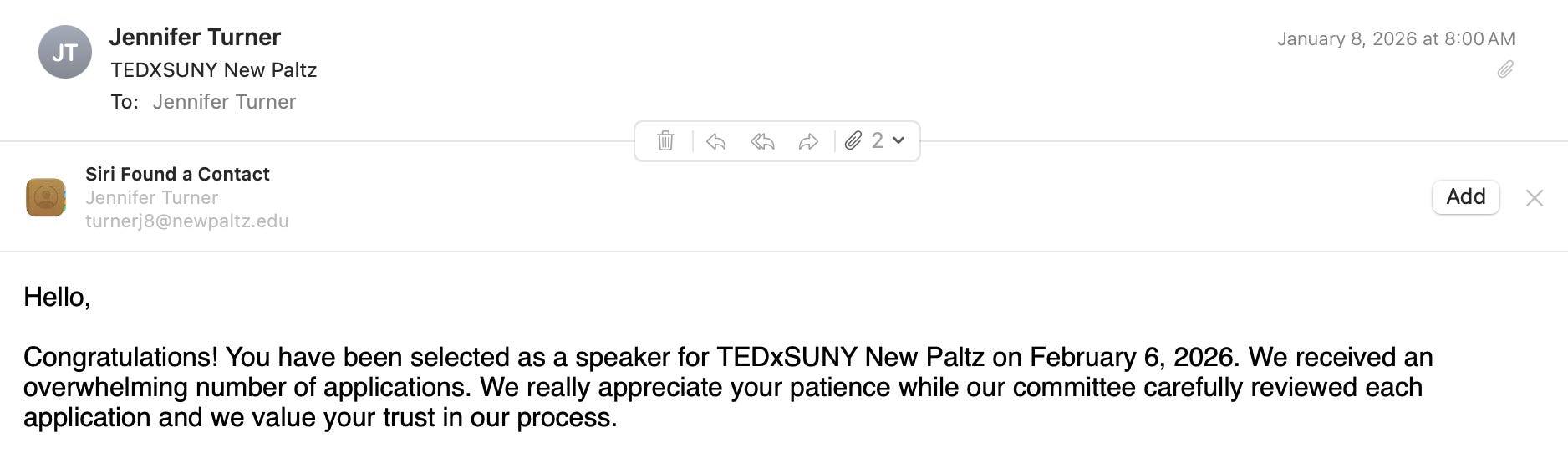
The timing felt almost comedic. I had spent so much energy building toward a single moment, and now I would be doing it again immediately.
When I got the email I came upstairs and showed my wife, thinking I honestly wouldn’t do it. Her response was: “Okay, great. Looking forward to seeing you up there twice.”
The second talk came together differently. It took six drafts and landed six minutes shorter. I built it from the ideas that didn’t fit into the first one — the gatherers, the nonlinear career paths, the cultural scripts that shape us before we know how to name them.
When I stepped onto the stage in New Paltz, I felt a different kind of weight in my body. I carried a small sheet of notes in my pocket and used it once without turning it into a moral crisis. I spoke more like myself. I let the audience breathe with me. I trusted that if something faltered, I would simply keep going.
The drama had already happened the night before. The fear of losing it and the choice to return.
At Princeton, I had learned I could lose the ground and return. At New Paltz, I didn’t lose it.
By the time I stood on that second red dot, I understood something I hadn’t fully grasped before.
The stage had never been the point.
The practice of returning had been building me all along.
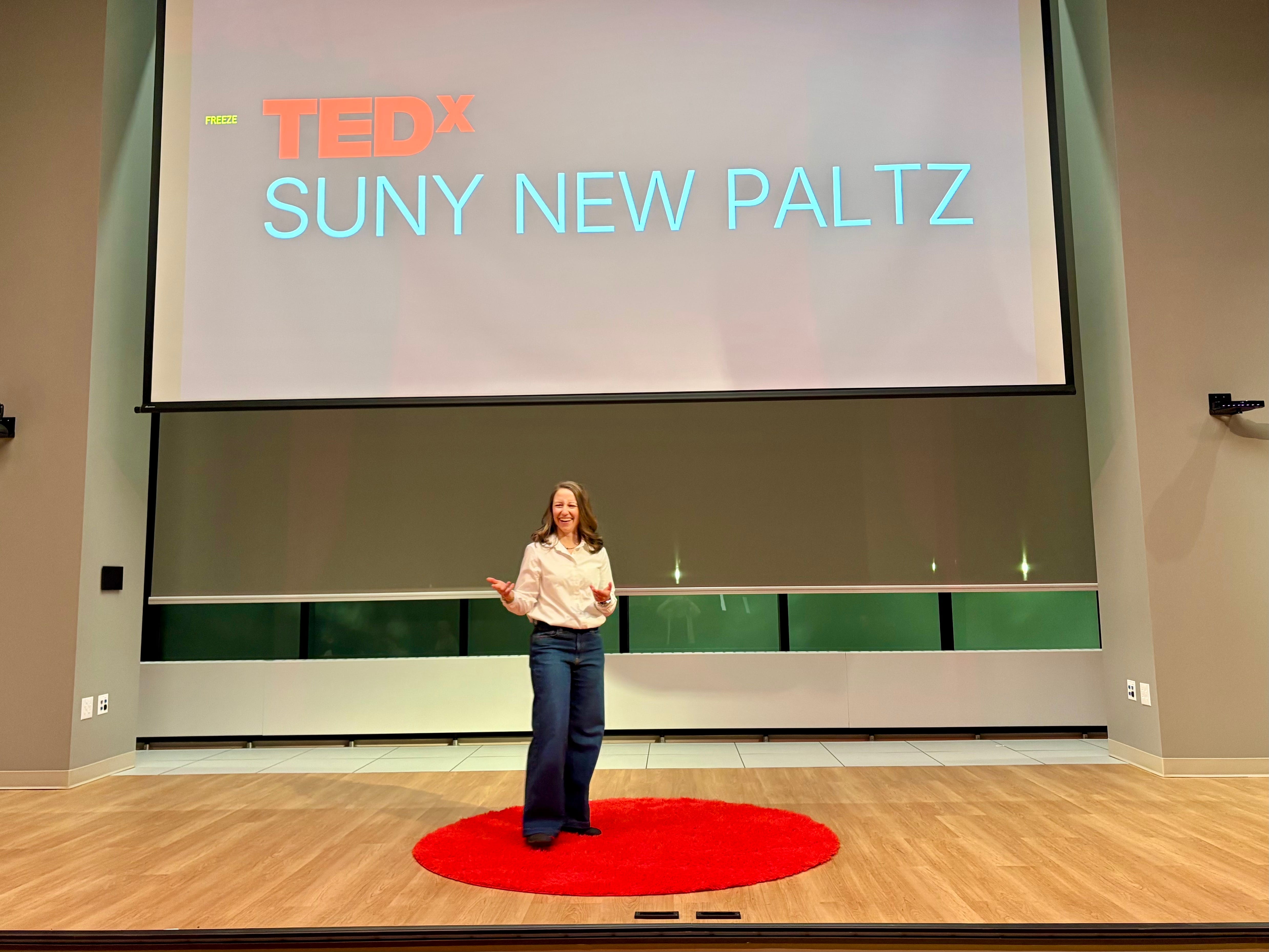
The Stage Is Visible. The Becoming Is Not.
I spent years trying to get chosen for a stage.
The real work was choosing myself.
The TEDx stage sits under bright lights. The becoming unfolds in studios with instruments, in margin comments that demand honesty, in rejection emails that sting, in drafts that ask who you actually are, in moments of silence on stage where you decide whether to continue.
Volunteering mattered. Rejections mattered (see below). Draft twenty-eight mattered. The freeze mattered.
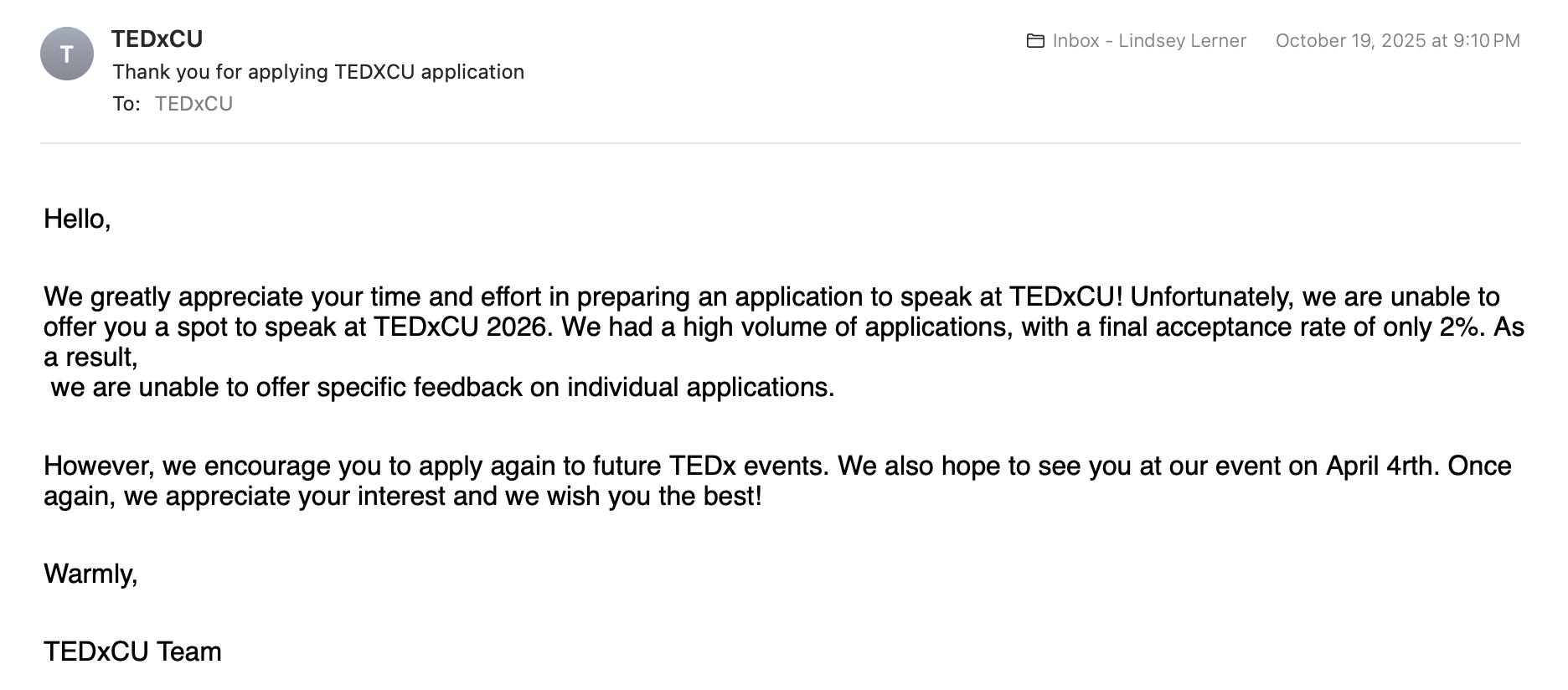
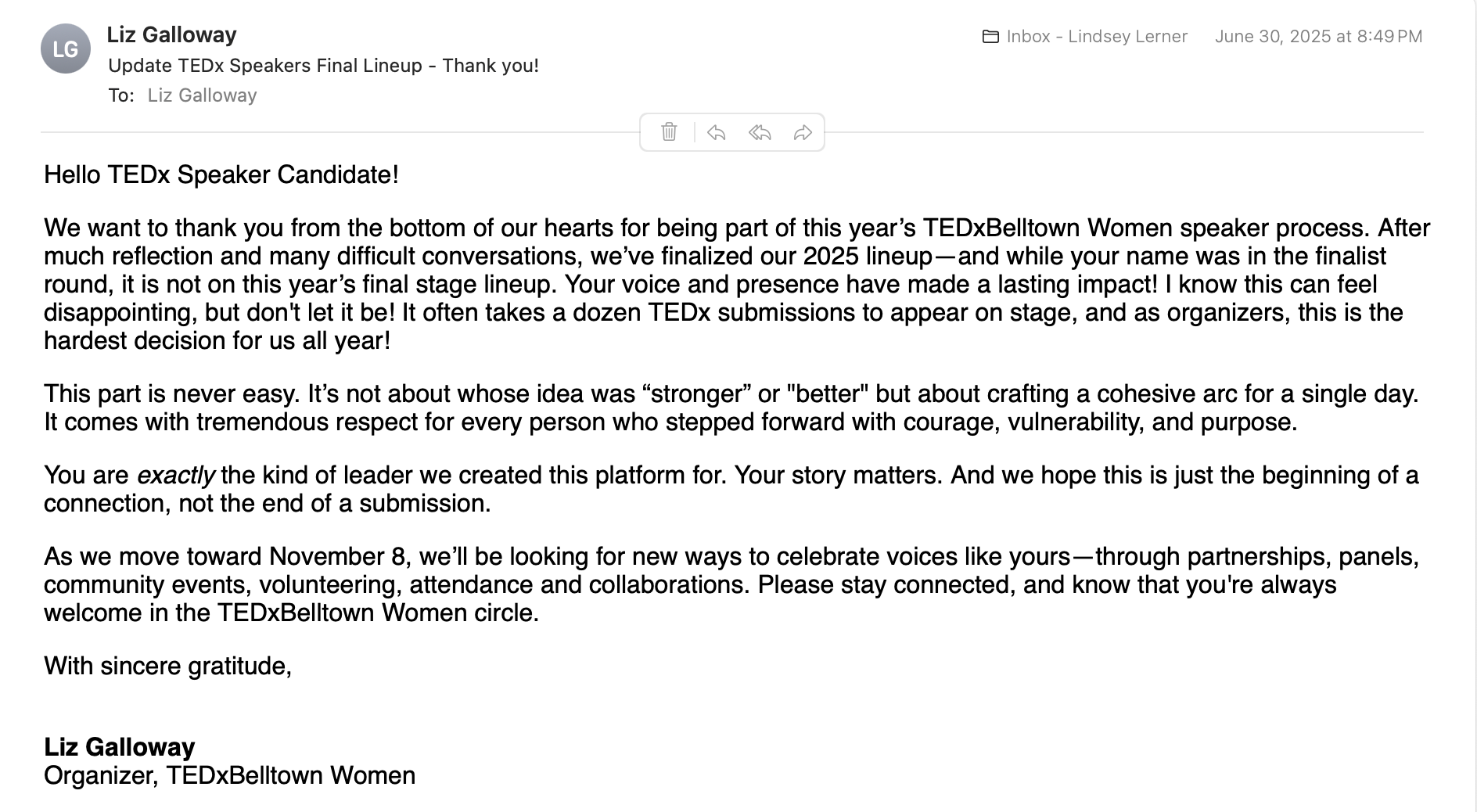
I reached that stage by doing invisible work long before anyone watched.
That is the part that changed me.
Stop fixing, start flowing,
Lindsey
And YES to this too: “I spent years trying to get chosen for a stage.
The real work was choosing myself.”
“The universe has a sense of humor and it is not subtle.” YES IT DOES